Wednesday, 7 August 2013

Welcome To Zero-Hours-Tolerant Newham

In the wake of the CIPD report this week suggesting that up to one million workers in the UK are on zero hours contracts – where an employee is expected to be on-call and is paid only for hours worked – the discovery that Newham council uses them has been highlighted on Mike Law's blog but hasn't yet made it into the Newham Recorder. The paper should probably pay more attention. This is a story that has the potential to deeply embarrass not only Newham Labour's council leadership but the national Labour Party too.

The Freedom of Information (FoI) request that reveals the number of staff on zero-hour contracts is buried deep within the FoI Disclosure logs on the council's website. So that others don't have to search for it, enquiry number 15701 on page 48 of the 228-page log for May 2013 says the following:

Subject: Zero Hour Contracts

I would like to know

(a) How many workers employed by the council are employed through zero hours contracts.

- I’d like figures in the financial year ending 2012-13 and
- for the financial year ending 2009-10

(b) For both years, I’d like a breakdown of workers employed in this way:
i – Directly through the council
ii – By private companies operating on council contracts

c) What percentage the figure is for each year of total council employees

The council's response was as follows:

1. A total of 1060 workers were employed by Newham Council through zero hour contracts during 2012/2013. This represented 7.6% of all of our employees as of the 31st March 2013. These are sessional workers, or casual staff who work on an as-and-when basis. They work largely in schools and community centres delivering advice sessions, tuition and sports coaching.

These sessional workers are not subject to a ‘mutuality of obligation’. That means they do not have to work when asked, nor are we obliged to ask them to work. All other employees are required to work to contract and we are obliged to provide them with their contracted hours.

A total of 1044 workers were employed in the same way through zero hour contracts during 2009/2010. This represented 7.6% of all employees as of 31st March 2010.

2. All of the employees holding zero hour contracts were employed directly through the Council. It is not possible for us to determine whether or not any of the private companies operating on council contracts during the periods given employed any staff on zero hours contracts.

3. As of 31st March 2013, 7.6% of all employees were on zero hour contracts.
As of 31st March 2010, 7.6% of all employees were on zero hour contracts.

Zero-hour contracts are the classic example of McJobs – it's no shock that 90% of McDonalds staff are on them. Not everyone thinks they are a bad thing – the almost comically blue-blooded Etonian Tory MP Jacob Rees-Mogg, a man who married an heiress, took his nanny with him when out canvassing and will never, ever experience what Jarvis Cocker called a life “with no meaning or control”, thinks zero-hour contracts are great for business. However, people I know who have been on them describe this type of contract making their lives more precarious – slashing their previously regular wages when introduced (by as much as 50%) and often leading to dismissal when their period of employment might lead to some actual rights (usually close the two-year mark). Equally, Newham council may talk about ‘mutuality of obligation’ and that workers are not forced to work when asked, but the experience of people I've spoken to (who mainly work in home care) is that refusing to accept on-call hours when asked means an employer stops ringing: you card is marked as 'unreliable'. This places enormous pressure to accept any hours, no matter how inconvenient, which makes the idea of having anything like 'quality time' equally precarious.

What makes the discovery that a significant number of Newham council staff – around one in every thirteen workers – are on zero-hour contracts so politically damaging for Labour is not just the decision of its leader Ed Miliband to highlight how “for too many people in Britain, the workplace is nasty, brutish and unfair” and to specifically condemn “the exploitation of zero hours contracts to keep people insecure” and .”using agency workers to unfairly avoid giving people the pay and conditions offered to permanent staff”. It's that this keynote 'One Nation' speech was made at Newham Dockside, the home of the zero-hours-tolerant Newham council.

It's damaging too because a statement that I wholeheartedly agree with by Dave Prentis, General Secretary of local government union UNISON, said:“the vast majority of workers are only on these contracts because they have no choice. They may give flexibility to a few, but the balance of power favours the employers and makes it hard for workers to complain”. Yet one Unison National Executive Committee member, John Gray. cannot possibly support his General Secretary without facing accusations of hypocrisy, because he is a Labour councillor in zero-hours-tolerant Newham council.

And it's damaging for precisely the reasons Mike Law has highlighted – that not one of the prospective Labour candidates standing for zero-hours-tolerant Newham council has had a single word to say on this issue.

Opposition to zero-hours contracts is apparently Labour Party policy. So will the party's 100% majority of local councillors - and the candidates who face inevitable election in 2014 - make a start on their leader's concerns about "our responsibilities to each other" by taking a stand in their own borough?

Thursday, 27 June 2013

How To Find Out What Secret Police Surveillance Says About You

On the face of it, this might seem like a very niche post. I've put this together primarily for activists involved in Newham Monitoring Project (NMP) and police custody deaths campaigners (including individual families and people at INQUEST) who may have been targeted for undercover surveillance revealed by the Guardian this week. It's based on my own Subject Access Request to the Metropolitan Police, submitted on Tuesday.

However, the steps below are just as applicable to anyone wanting to find out what personal details are held about them by the police, for example on the National Domestic Extremism database. There is a 2011 guide on the Guardian website - note that some details (such as who to make payment to) have since changed.

Why make a request?

The revelation that undercover surveillance by the Special Demonstration Squad during the 1990s targeted the Lawrence family, police custody death campaigners and organisations that supported them - people involved in lawful campaigning activities - is alarming but incomplete. The Guardian's report doesn't name of the SDS officer who targeted NMP and we have no idea how widespread the surveillance was or what was included in the so-called 'intelligence' reports.

The Metropolitan Police are likely to resist calls for the release of this information, but a flood of Data Protection Act Subject Access Requests will at least force the Met to examine their records and confirm or deny whether information was gathered. They could potentially help everyone to understand whether, as I suspect, the 'intelligence' was nothing more than gossip and rumour designed to smear campaigners.

As the process involves handing over a certain amount of personal information (including your address and your date and place of birth), it is only worthwhile submitting a Subject Access Request if you think there is a chance that your details are held on police records. There is no point feeding the surveillance officers with information they don't already possess.

Writing a Subject Access Request

First, download MPS Subject Access Form 3019 - there is a Microsoft Word version or a PDF on the Metropolitan Police website.

After completing the personal information sections, Section 3 asks:

Please specify exactly what information you require (e.g. Crime Report)?

I have written:
I require any information about myself gathered by the former Special Demonstration Squad and subsequently by the National Domestic Extremism Unit.
In response to the question "What happened to cause you to have contact with the police?", I have added:
Recent news coverage has indicated that undercover officers from the Special Demonstration Squad were responsible for covert surveillance on a number of groups including the Newham Monitoring Project (NMP) and justice campaigns concerned with deaths in police custody. As I have been actively involved in NMP since 1990 and was the secretary from 1997 of the United Families and Friends Campaign, the umbrella group for many of these campaigns, I wish to find out whether this undercover surveillance gathered information on me.
This is obviously personal to me. If you were involved in what the Guardian refers to as "associated groups", such as a family campaign, INQUEST or another organisations, then you need to add you own concerns why the SDS may have included you in its nefarious activities.

Under "When did this happen?" I have said:
Potentially between 1990 and 2008 for the former Special Demonstration Squad and from 2008 until the present date for the National Domestic Extremism Unit
The National Domestic Extremism Unit took over the work of the Special Demonstration Squad in 2008. If, like me, you are still a campaigner, then it is worth finding out whether there is any more recent 'intelligence' about you.

The Metropolitan Police Commissioner Sir Bernard Hogan-Howe may have told the London Assembly today that "we are now in a different context... the main reassurance I can offer you is that we are aware it has been alleged in the past, I don't want it to happen in the future... and I don't believe it is happening at the moment." However, if the National Domestic Extremism Unit is prepared to gather data on an 88-year-old man sitting in a folding chair drawing sketches at demonstrations, then it is capable of anything.

In response to the question "Where did this happen and how was it reported?", I've have said:
Unknown – the alleged covert surveillance most likely took place in the London borough of Newham but potentially could have happened anywhere in London.

Again, this will need amending, depending on your individual circumstances.

Submitting your Subject Access Request

You need to send a cheque, British postal order or international bankers draft for £10 payable to 'Mayors Office for Policing and Crime' and two forms of identification that "provide sufficient information to prove your name, date of birth, current address and signature." This means a driving licence, medical card, birth/adoption certificate or passport, along with a recent utility bill or bank statement.

I sent a copy of my passport and a photocopy of a gas bill - both a bank statement and definitely a telephone bill seemed like a really bad idea!

The form, payment and identification should be sent to:

Metropolitan Police Service
Public Access Office
PO Box 57192
London
SW6 1SF

Don;t forget to keep a copy. If you do not receive confirmation that the data protection officer has received your request within two weeks, ring the Public Access Office on 020 7161 3500 and ask to speak to the data protection unit, or email publicAccessOffice@met.police.uk.

What happens next?

You are entitled under the Data Protection Act to receive an answer within 40 days but no-one, it seems, ever receives a response in that time. The Metropolitan Police is so bad at responding to requests for information that in April, it was one of three public authorities the Information Commissioner’s Office said it planned to monitor over concerns about its timeliness.

The Met may decide to withhold information, but it must clearly explain why. As the activities of the SDS relate to historic surveillance of lawful campaigning, it will be interesting to see what excuses they come up with.

You can challenge any denial of information by lodging an appeal, and asking the department to reconsider the decision. The Network for Police Monitoring (which Newham Monitoring Project is a member of)  is currently putting together guidance on following up Subject Access Requests and when it is ready, I'll make this available.

UPDATE

Thanks to Emily for this: a Freedom of Information request from last year confirms that Special Demonstration Squad data "was amalgamated into a MPS system and is not held in a standalone searchable database". This is likely to cause delays but does suggest that the data exists and was kept.

Tuesday, 25 June 2013

We Must Have A Far-Reaching Inquiry Into Police Spying

This is a piece I wrote for Red Pepper on today's revelations that undercover police spied on Newham Monitoring Project and campaigns for justice for those that died custody

Today’s new development in the long-running exposure of undercover police targeting campaigners has suddenly became very personal. The Guardian reported that covert officers from the former Special Demonstration Squad had spied on a number of organisations concerned with corruption and harassment within the Metropolitan Police, including the east London community group Newham Monitoring Project (NMP), and on justice campaigns for people who had died in custody. I have been an activist for NMP for 23 years and from 1997 to 2007 was the secretary of the United Families and Friends Campaign, an umbrella group of custody death families. It seems likely my name appeared in some of the secret so-called ‘intelligence’ reports.

I’m disturbed that NMP was targeted but not entirely shocked. In some ways it might be seen as a positive reflection on our effectiveness in exposing cases of police misconduct and how worried senior officers had become about the damage that the actions of some of their officers was inflicting on the Met's reputation. I certainly know the police have never been able to get their heads around what motivates independent grassroots activism: how campaigns emerge from practical casework rather than, say, an attempt to recruit people to a party and how supporting individuals and families suffering injustice makes the anger that drives a desire for answers feel very personal.

Furthermore, the fact that a decision was made to spy on an organisation whose events were open to the public and whose activities were reported in great detail in our annual reports and publicity says more about the Metropolitan police than it does about NMP: it illustrates the deep level of resistance to accountability within London’s police during the period when the Special Demonstration Squad were snooping around our activities.

However, I’m appalled and angry too, that campaigns NMP advised and supported that were set up and sustained by bereaved families struggling for justice for their loved ones after a death in police custody – always in the face of overwhelming hostility from every part of the criminal justice system – may have been targeted for covert surveillance, for no other reason than to try and undermine them. I can only imagine that, in the absence of any actual ‘plotting’ by these campaigns, undercover officers were simply busy trying to find out more about families' legal strategies or looking for gossip and rumour that they could use to smear ordinary people forced into extraordinary circumstances by grief and the need to find the truth.

On top of the allegations of serious sexual misconduct and betrayal by undercover police and the stories of identities stolen from dead babies, the shameful targeting of the bereaved now means the case for an independent public inquiry is overwhelming. The Home Secretary’s insistence that the current investigation by Derbyshire’s Chief Constable is adequate lacks any credibility. We need a far-reaching and robust inquiry to find out what so-called ‘intelligence’ was gathered by officers, who ordered the surveillance and how it was used. Just as importantly, we urgently need to know to what extent the successors to the Special Demonstration Squad, such as the National Domestic Extremism Unit, are still secretly targeting campaigners.

Personally, I and other NMP activists also really want to know the fake identity and the real name of the officer that we may have inadvertently worked with in good faith. I want to know what kind of person pretends to support campaigns for justice but instead was secretly working to try and prevent the truth from ever emerging. For the sake of the transparency and accountability we have always demanded, the Metropolitan police owe all of us that, especially all the people we have supported over the years.

Monday, 17 June 2013

Photos from 'They Owe Us' Protest at Canary Wharf

In response to the combined crises of cuts and climate chaos and the call for a week of action against the G8, a number of campaigners including UKUncut, Fuel Poverty Action and Disabled People Against the Cuts came together on Friday to protest in Canary Wharf - what they called "the penthouse suite of global capitalism".

Technically the protest was illegal -in 2011, its owners Canary Wharf Group obtained an indefinite injunction that prohibits "any persons unknown remaining on the Canary Wharf estate in connection to protest action" (all 14 million square feet is private land). The police presence on Friday was pretty heavy for a small protest of 150 people and as usual, Forward Intelligence Team photographers from the Metropolitan Police were busy gathering information for the police 'domestic extremist' database, but the event was entirely peaceful. Here are a few photos I took - the set is on Flickr here

Thursday, 25 April 2013

Launch of New Local Activists' Network "The People's Republic of Newham"

I am one of those who has long felt that local campaigners would really benefit from closer cooperation, so I'm pleased to be part of the launch of "The People's Republic of Newham", a network of local independent activists who want to try and help and support community campaigns by sharing the wealth of knowledge, skills and experience in the borough.

Local communities are increasingly required to using campaigning tactics to defend services, resources and rights in the face of indifference from largely unaccountable local institutions.There is also an urgent need for local campaigns to support and learn from each other. The "People's Republic of Newham" is an attempt to bring together campaigners and look at mutual support and skill-sharing. It currently organising on Facebook but if there is enough interest, it can expand to an email group and meetings, depending on what members feel is most helpful.

Let's see. Meanwhile, please invite other local activists you know and who you think should be part of the network to get in touch. You can find the page at https://www.facebook.com/PeoplesRepublicofNewham

Wednesday, 17 April 2013

The End of Thatcher

I've been saving these for today, because of the inevitable sycophancy that surrounded today's state-sponsored Conservative Party rally. These photos are from Saturday's "Thatcher's Dead" party in a rain-drenched Trafalgar Square.

Sunday, 14 April 2013

UKUncut Protest Against The Bedroom Tax

Photos from yesterday's UKUncut protest against the bedroom tax, outside the "spare" home of Parliamentary Under Secretary of State for Work and Pensions, Lord Freud.

Monday, 1 April 2013

How Credible is Call for Referendum on Newham's Mayor?

It's been a while since I last blogged – the imminent prospect of redundancy has kept me busy these past weeks. There has, however, been loads of things that I've wanted to comment on and one of those is the announcement by George Galloway's latest project, the inappropriately named Newham People’s Alliance (NPA), that plans have been hatched to start a petition calling for a referendum on Newham's mayoral system. On 10 March, the NPA website briefly announced:
In an NPA meeting on Friday night in East Ham, over 100 local community and religious leaders voted unanimously to press ahead to trigger a referendum on the mayoral system. This comes after years of disengagement, faith-phobia, gagged representatives, and trophy projects at the expense of the ordinary people in one of the poorest and most disenfranchised communities in the country.

The NPA will be working closely with its legal team and the Department for Communities and Local Government to submit a petition in the coming months.
That was three weeks ago – and since then, not a word.

Don't get me wrong: if there is a realistic prospect of securing 10,000 local signatures for a petition to get rid not only of Newham Mayor Sir Robin Wales but also the system that enables him to operate with little accountability, then I'm in. I wrote a blog post on how it could be done as far back in December 2011, after all. However, as I warned in a follow-up in January last year, collecting enough signatures is only half the battle:
“...even if there are enough people willing to put in the hard work to collect signatures and trigger a referendum, any local 'Bring Back Democracy' campaign would also need to be brilliantly organised, better than anything the borough has seen previously. It would need the confidence to guarantee that enough people actually turn out to vote for change: in January 2002, the referendum that created the Mayor and Cabinet system had only a 26% turn-out. That would mean ward-by-ward voter mobilisation, lots of willing volunteers and money: enough to pay for publicity to cover over 91,000 households. ”

In other words, trying to trigger a referendum is not a decision made without a great deal of thought. Get it wrong and the Localism Act prevents another challenge for ten years.

Having worked with Newham's voluntary and community sectors for over a decade, I know there are hundreds of people who will sign a petition for a referendum. I'm just far less convinced that the Newham People's Alliance, which its links to the Respect party and its close identification with the specific concerns of a section of Newham's Muslim communities, has either the capacity or is sufficiently broad-based to coordinate a campaign that is better organised than anything the borough has seen before.

Certainly, in the weeks since the NPA announced its intention to trigger a referendum, there has been little evidence of initial momentum: no attempts at coordination with potential allies, no call for open discussion about the potential obstacles faced, silence on the need to debate more sweeping reforms that might convince local people this isn't just a dull procedural change aimed at returning to the way things were in 2001. Instead, the announcement looks too much like a stunt, an opening shot in Respect's campaign for Yvonne Ridley's candidacy for MP in two years time. And if that's all it it is, then it will fail.

The election for the next Mayor of Newham is in May 2014, which leaves little time for the steps necessary to abolish the mayoral system itself. I really wish a genuinely broad 'Bring Back Democracy' campaign in Newham was possible - but I fear a half-hearted one even more.


Friday, 1 March 2013

Viewing London From The Shard

On Wednesday, I went up to floors 68, 69 and 72 of the Shard building by London Bridge, which is the highest public viewing platform in London at 244m (800ft) above the city, to take some photographs. There are a number in colour on Flickr - but these, rendered into beautiful black and white, are my favourites.

Monday, 18 February 2013

Photographing Chiang Mai's "Soi-Art"

Last night I returned from a fortnight's holiday in northern Thailand, where I visited one of my closest friends who has just had given birth to a gorgeous baby girl. The trip provided a welcome opportunity to think about how to respond to the threat of impending redundancy whilst spending time with my new not-god daughter and exploring and photographing Chiang Mai's Old City.

Holiday photos can be a bit predictable - I have plenty of pictures of temples but after noticing the amount of street graffiti as I wandered between cafés and food shacks in the blazing heat of the day, I managed to spend an enjoyable afternoon taking photos of some of the city's "soi-art":

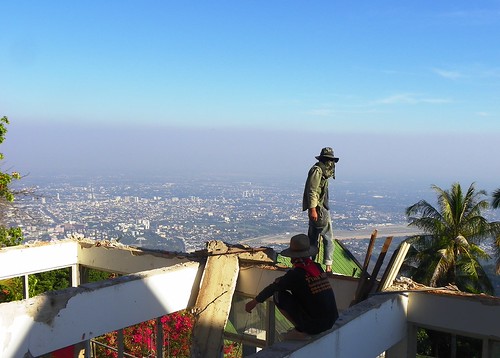
I'm also really pleased with this photo - at the Buddhist temple on the Doi Suthep mountain overlooking Chiang Mai, I noticed some workers knocking down the shell of a building with little regard for concerns about health and safety:
100_4569
Anyway, it's good to be back, although I still don't know what is happening about my future employment. I hope to know a little more later this week.

Random Blowe | Original articles licensed under a Creative Commons License.

BACK TO TOP